

Google’s review policy says every review must come from a real customer describing a real experience, posted freely. Businesses must not buy reviews, offer discounts or gifts for reviews, ask staff or family to review, ask only happy customers, pressure customers on the premises, set staff review quotas or post fake reviews on competitors. Breaking these rules can lead to removed reviews, public warnings, paused reviews and suspension. The safe way to grow is to ask every customer for an honest review and reply professionally to all of them.
Key takeaways
- Every Google review must be based on a real customer experience.
- Paid, incentivised and staff or family reviews break Google’s policy.
- Review gating, staff quotas and asking for specific content are prohibited.
- Google removed or blocked 292 million policy-violating reviews in 2025.
- Penalties include removed reviews, profile warnings, paused reviews and suspension.
- The safe method: ask every customer, make it easy and reply to every review.
Google reviews are one of the strongest signals for local search and one of the first things customers check before they call, visit or book. That makes them valuable, and it is exactly why some businesses are tempted to take shortcuts. In 2026 those shortcuts are riskier than ever. Google now removes hundreds of millions of policy-violating reviews every year, shows warnings on profiles caught with fake reviews and can pause reviews altogether.
This guide explains Google’s review policy in plain language, the common ways people try to bypass it, why those methods fail, what happens when a business gets caught and, most importantly, the safe and effective way to build genuine reviews for your business in Kottayam or anywhere in Kerala.
What is Google's review policy?
Google’s rules for reviews sit inside the Google Maps user contributed content policy. The policy applies to everyone who posts or requests reviews: customers, business owners, staff and marketing agencies. The parts that matter most for businesses are grouped under three headings.
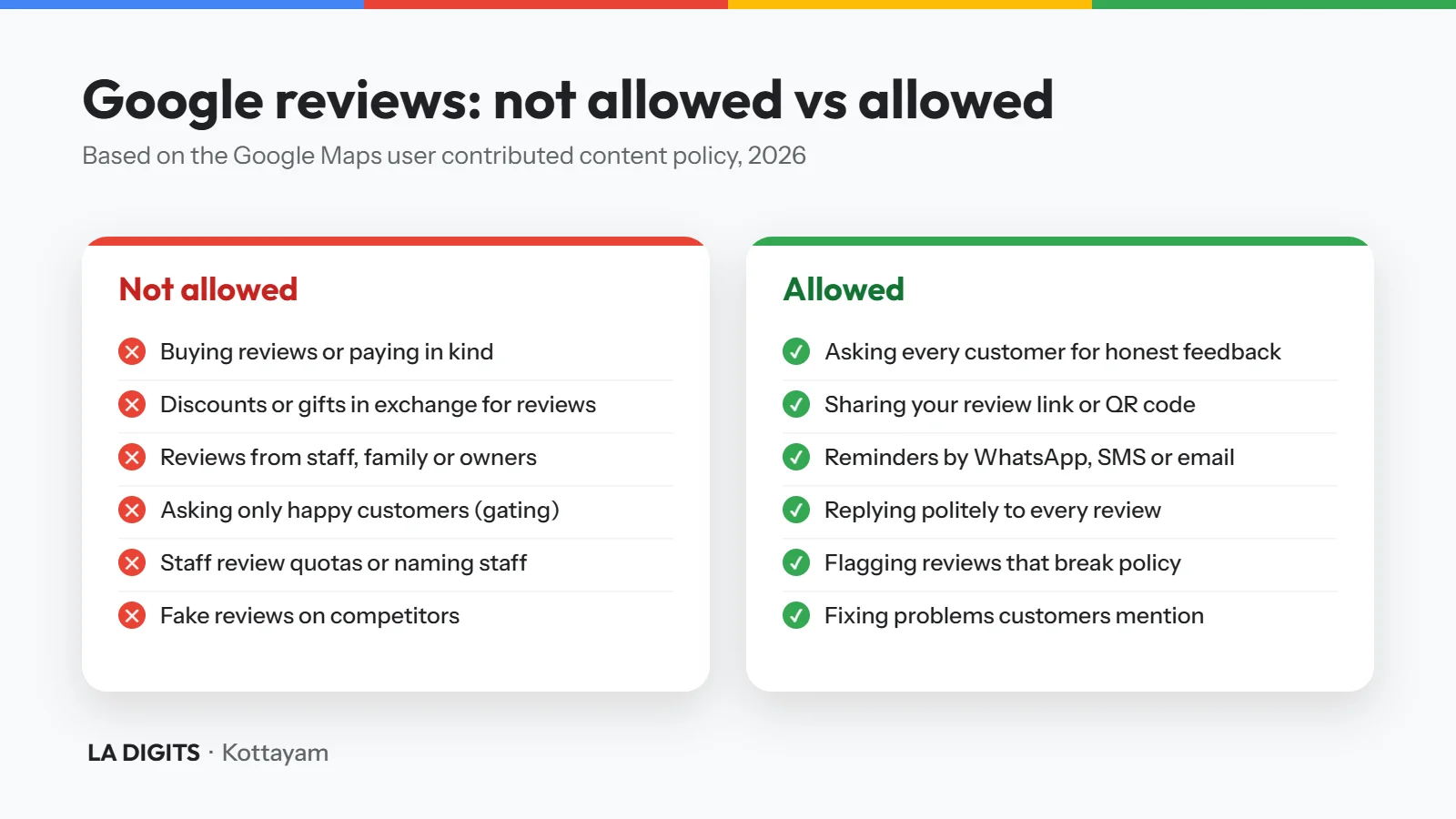
- Fake engagement: reviews must be based on a real experience. Paid reviews, reviews posted from multiple accounts and reviews written for a business by its owner or staff are not allowed.
- Rating manipulation: businesses must not use incentives, unusual volumes of reviews or selective requests to push their rating up, or push a competitor’s rating down.
- Conflict of interest: reviews from current or former employees, contractors, family members, business partners or competitors are not allowed, whether positive or negative.
Why Google is stricter than ever in 2026
Google has steadily increased enforcement, and the numbers show how seriously it takes review abuse.
- 292 million policy-violating reviews were blocked or removed in 2025, according to Google’s Maps trust and safety report published in April 2026, alongside more than 13 million fake Business Profiles.
- Warning notices: in India, the US and the UK, Google can show customers a notice that suspicious reviews were recently removed from a profile, and Google announced these warnings would expand worldwide from 2025.
- Customer reporting: since around September 2025, Google Maps has asked visitors whether a business offers rewards in exchange for reviews, and those answers can lead to reviews being removed.
- New rules on staff: in April 2026, Google added rules that stop businesses from setting review quotas for staff or asking staff to collect reviews with specific content, including reviews that name a staff member.
- Faster detection: Google uses AI models to spot unusual patterns before reviews go live and can revisit old reviews months later.
12 ways people try to bypass Google review rules (do not do these)
These are the shortcuts we see most often in Kerala and around the world. Every one of them breaks Google’s policy, and most of them are easier to detect than people think.
1. Buying reviews
Paying a website, freelancer or “review service” for five-star reviews is the most obvious violation. These reviews usually come from accounts with no real history, appear in bursts, use similar wording and are posted from locations far from your business. Google’s systems are built to catch exactly these patterns, and paid reviews are often removed within days or weeks, taking your money and your rating with them.
2. Reviews from staff, family and friends
Asking employees, relatives or friends to post reviews feels harmless, but it is a conflict of interest under Google’s policy. These reviews often share devices, Wi-Fi networks and locations with the business owner, which makes them easy to link together.
3. Review swap groups
WhatsApp and Facebook groups where business owners agree to review each other are common. Reviews exchanged this way are not based on a real experience and create a network of connected accounts that Google can identify and remove together.
4. Discounts, gifts or freebies for reviews
“Leave a review and get 10% off” or a free dessert for a five-star rating counts as an incentive, even if you do not ask for a positive review. Google’s policy prohibits payment, discounts and free goods or services in exchange for reviews, for changing a review or for removing a negative one.
5. Review gating
Review gating means asking customers how happy they are first, then sending only satisfied customers to Google while unhappy customers are sent to a private feedback form. Google explicitly prohibits selectively soliciting positive reviews. Ask every customer, or ask none.
6. Pressure on the premises
Handing customers a tablet at the counter and waiting while they write a review, or refusing to let them leave until they do, breaks the rule against requiring or pressuring customers to review while on your premises. A QR code they can scan later is fine.
7. Staff quotas and staff-name campaigns
Since April 2026, setting targets such as “every staff member must collect 20 reviews a month”, or running contests where staff win prizes for reviews that mention their name, is specifically prohibited. It also tends to produce rushed, repetitive reviews that look unnatural.
8. Scripts and keyword-stuffed reviews
Asking customers to include specific words, such as “best dental clinic in Kottayam”, or giving them a ready-made review to paste, is asking for specific content. Reviews that repeat the same phrases look manipulated to both customers and Google, and they add little ranking value.
9. Multiple accounts, VPNs and emulators
Creating several Google accounts, using VPNs or device emulators to look like different customers, or paying someone who does, is fake engagement. Google tracks device and account signals specifically to catch this.
10. Fake negative reviews on competitors
Posting one-star reviews on a competitor’s profile, or paying someone to do it, violates the policy and can expose you to defamation claims. It also damages trust in your own business if it is ever traced back to you.
11. Paying to remove reviews
Some services promise to remove negative reviews for a fee. Google only removes reviews that break its policy, and no third party can guarantee removal. Offering a customer money or a refund to delete or change their review is also prohibited.
12. AI-generated reviews and fresh profiles
Using AI tools to write batches of reviews, or creating a new Business Profile to escape a poor rating, are newer tricks. AI-written reviews still need fake accounts to post them, and duplicate or misleading profiles can lead to suspension of every profile involved.
What happens if Google catches you?
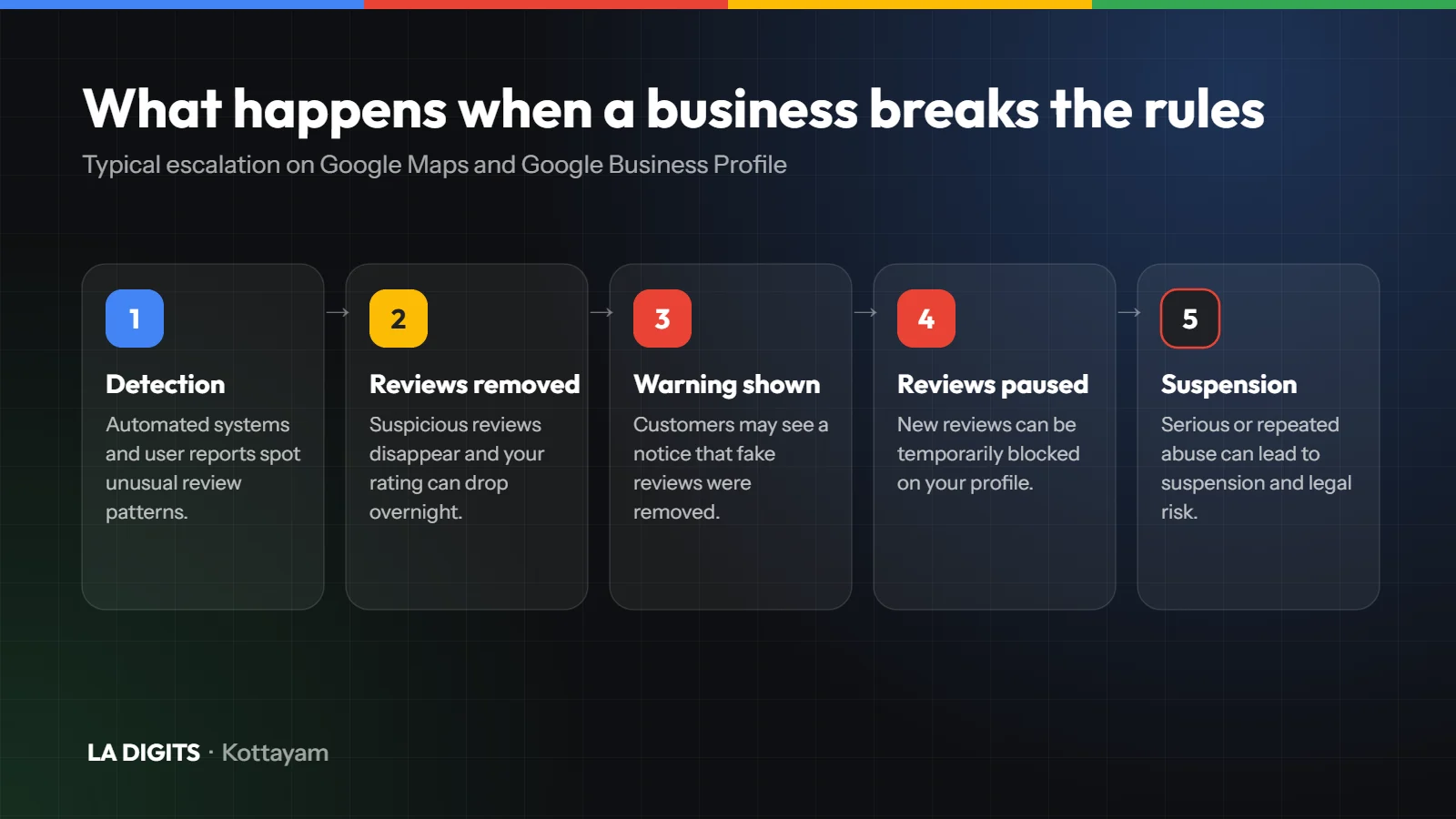
Penalties usually escalate. A single suspicious review may simply disappear, while repeated or large-scale manipulation can affect the whole profile.
| Consequence | What it means for your business |
|---|---|
| Reviews removed | Fake or incentivised reviews disappear, often in bulk, and your star rating can drop overnight. |
| Warning on your profile | Customers may see a notice that suspicious reviews were removed, which damages trust before they read a single review. |
| Reviews paused | Google can temporarily stop new reviews from being posted on your profile, including genuine ones. |
| Lower visibility | A damaged profile can lose positions in Google Maps and the local results, which means fewer calls and visits. |
| Profile suspension | Serious or repeated abuse can lead to the profile being suspended or removed from Google Maps. |
| Legal risk | Fake reviews can count as misleading or unfair trade practices under consumer protection laws in India and abroad. |
The legal side: India and abroad
Review manipulation is not only a Google policy issue. In India, misleading claims and unfair trade practices are covered by the Consumer Protection Act, 2019, enforced by the Central Consumer Protection Authority. The Bureau of Indian Standards also published IS 19000:2022, a standard for how online platforms collect, moderate and publish consumer reviews, created in response to the growth of paid and fake reviews.
If you serve customers abroad, the rules are stricter still. In the United States, the Federal Trade Commission introduced a rule in 2024 that bans buying and selling fake reviews and allows civil penalties. In the United Kingdom, fake reviews became a banned practice under consumer law from April 2025. This article is general information, not legal advice, so speak to a lawyer about your specific situation.
What is allowed: the safe way to get more Google reviews
The good news is that genuine reviews are not hard to get when you ask consistently and make it easy. These methods are fully within Google’s rules.
- Ask every customer. Make a polite review request a normal part of finishing every job, sale or appointment, not only for customers who seem happy.
- Share your direct review link. Copy the “Ask for reviews” link from your Google Business Profile and use it in WhatsApp messages, emails, invoices and receipts.
- Use a QR code. Place it at the billing counter, reception, on packaging or on a thank-you card so customers can review later, in their own time.
- Send one gentle reminder. A single follow-up a few days later is helpful. Repeated chasing is not.
- Time it well. Ask soon after a good experience: when a treatment is complete, a product is delivered or a project is handed over.
- Make it simple. Tell customers it takes under a minute and that a few honest words are enough.
- Train your team on the rules. Staff can mention reviews, but without quotas, scripts, prizes or pressure.
Here are request templates you can adapt. Notice that none of them mention stars, offers or specific words.
Do and don't checklist
| Do | Don’t |
|---|---|
| Ask every customer for an honest review | Ask only customers you know are happy |
| Share your review link and QR code | Offer discounts, gifts or cashback for reviews |
| Send one polite reminder | Pressure customers to review at the counter |
| Reply to every review professionally | Write reviews yourself or ask staff and family |
| Flag reviews that clearly break policy | Pay anyone to post or remove reviews |
| Fix the problems reviews point out | Join review swap groups or buy reviews |
| Let staff mention reviews naturally | Set staff quotas or ask for their names in reviews |
How to handle negative and fake reviews the right way
Negative reviews are not the end of the world. A profile with only perfect five-star reviews can look less believable than one with a few honest criticisms and thoughtful replies. What matters is how you respond.
- Reply calmly and quickly. Thank the customer, acknowledge the issue, avoid arguing and offer to resolve it offline by phone or WhatsApp.
- Never offer anything to change the review. You can fix the problem, but do not offer money, refunds or gifts in exchange for editing or deleting a review.
- Flag reviews that break policy. Spam, abuse, off-topic content, conflicts of interest and reviews from people who were never customers can be reported through the review management tools in your Google Business Profile.
- Do not retaliate. Never post fake reviews on a competitor you suspect, and never reveal a customer’s private details in a reply.
- Watch for extortion. If someone floods your profile with one-star reviews and demands payment to remove them, do not pay. Keep screenshots, report the reviews to Google and contact Google Business Profile support.
Professional replies also help your local ranking and conversion. Customers read your responses, and Google sees an active, engaged business. If reviews are a constant worry, our online reputation management team can help.
A simple monthly review routine for Kottayam businesses
- Week 1: check that your review link and QR code work, and that every staff member knows how to share them.
- Every day: send the review link to customers after each completed job, sale or appointment.
- Twice a week: reply to all new reviews, positive and negative.
- Every month: read reviews for recurring themes, such as waiting time, pricing or staff behaviour, and fix what customers mention.
- Every quarter: review your Google Business Profile photos, services and description so the profile matches what customers say about you.
Steady, genuine reviews over months build a far stronger profile than a sudden burst of suspicious ones. For a complete local plan, read our guide on how to rank higher on Google Maps.
How LA DIGITS helps businesses grow genuine reviews
LA DIGITS manages Google Business Profiles for businesses across Kottayam, Kerala and abroad. We set up compliant review systems with review links, QR codes and WhatsApp templates, train your team on what is allowed, write professional replies, report policy-violating reviews and track your rating and visibility month by month. We never buy reviews, use review swap groups or gate feedback, because shortcuts put your profile at risk. Learn more about our Google Business Profile management and local SEO services.
Google review policy: frequently asked questions
Is it legal to buy Google reviews in India?
Buying reviews breaks Google’s policy and can be treated as a misleading or unfair trade practice under the Consumer Protection Act, 2019. It also risks review removal, warnings and suspension of your Business Profile.
Can I offer a discount for a Google review?
No. Google prohibits offering payment, discounts, free goods or services in exchange for a review, even if you do not ask for a positive one.
Can my employees or family leave a review for my business?
No. Reviews from current or former employees, family members and business partners count as a conflict of interest under Google’s policy.
What is review gating?
Review gating means asking customers about their experience first and sending only happy customers to Google. Google prohibits selectively soliciting positive reviews.
Can I ask customers to mention a staff member or keywords?
Since April 2026, Google’s policy says businesses must not ask staff to collect reviews with specific content, including content that identifies a staff member. Asking customers for specific keywords is also asking for specific content.
Can I ask customers for reviews at all?
Yes. Asking customers for honest reviews is allowed and encouraged. Share your review link or QR code with every customer, without incentives, pressure or selection.
How does Google detect fake reviews?
Google uses automated systems and AI models that look at account history, devices, locations, timing, wording patterns and user reports. It can remove reviews before they appear or months after they are posted.
What happens if Google finds fake reviews on my profile?
Google can remove the reviews, show customers a warning that suspicious reviews were removed, temporarily stop new reviews and, for serious or repeated abuse, suspend the profile.
Can I pay someone to remove a negative Google review?
No. Only Google can remove reviews, and only when they break its policy. Offering a customer money or a refund to delete or change their review is also prohibited.
How do I report a fake review on my Google Business Profile?
Use the review management tools in your Google Business Profile to report the review and choose the reason that applies. Keep evidence, such as proof the person was never a customer.
What should I do if someone demands money to remove bad reviews?
Do not pay. Take screenshots, report the reviews to Google, contact Google Business Profile support and consider informing the police cyber cell.
Do negative reviews hurt my Google ranking?
A few negative reviews are normal and can make your profile more believable. Your overall rating, the number and freshness of genuine reviews and your replies matter more than any single review.
How many Google reviews does a local business need?
There is no fixed number. Aim for a steady flow of genuine reviews every month and compare yourself with the top competitors in your area on Google Maps.
Can LA DIGITS get me more Google reviews?
We do not post or buy reviews. We help you get more genuine reviews by setting up review links, QR codes, WhatsApp templates and staff training, and by managing replies and your profile within Google’s rules.
Sources
- Google Maps user contributed content policy: fake engagement and rating manipulation
- Search Engine Roundtable: Google Maps blocked 292 million reviews in 2025
- PPC Land: Google bans staff review quotas and staff-name requests (April 2026)
- PPC Land: Google Maps asks users if businesses offer rewards for reviews
- 9to5Google: Google Maps fake review warnings
- MediaNama: India’s IS 19000:2022 framework for online consumer reviews
